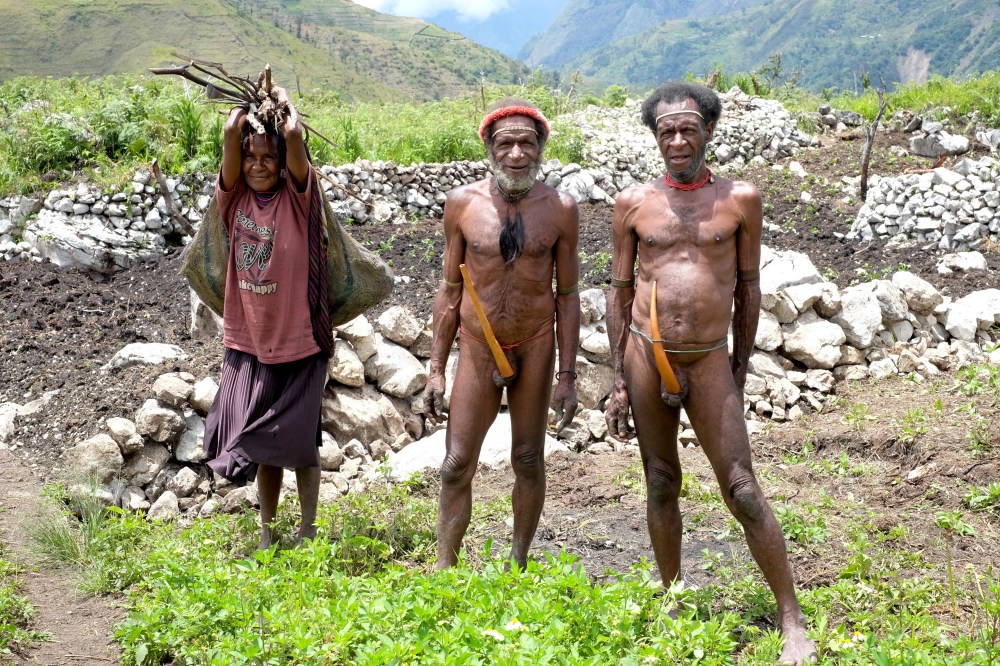
This part of my trip came about unexpectedly and so I didn’t get to explore as deeply into the Bailem Valley as I would have liked. But I did get to take some excellent photos of the famous locals in their typical garb, and it was enlightening to see the stark differences between independent Papua New Guinea and Indonesian-occupied West Papua.
The land border crossing between the two countries is an ornate, golden gate adorned with swirling figures and motifs. It’s distinctly Asian in style and like nothing I’d seen anywhere in Papua New Guinea. The roads leading to and from the gate on the Indonesian side are paved and unbroken. On the west of the world’s third biggest island, ordinary cars are the norm. The first 4×4 I saw was a Dihatsu Gran Max; a miniature cousin of the Hilux’ and Land Rovers used on the east of the island; a vehicle that would frankly wilt at even the whiff of a genuine PNG pothole. Immediately, everything was very much South East Asian. Loud music, emanated from cars and houses. Everything became much more urbanised; concrete buildings, connected high streets, neon lights. There are scooters everywhere.
Something else I was then faced with was backpackers. In the month I spent in Papua New Guinea I met very few tourists and not a single backpacker. It was nice to meet likeminded travellers, but it also made everything seem a little less interesting.
The Bailem Valley is a short flight from West Papua’s capital, Jayapura. Wamena, the nearest town to the valley, is like an Asian Wild West movie set. There I arranged my guide and organised supplies; including the boxes of cigarettes and sweets I had been told I would need to give to the native Papuans living in the valley.
My guide and I were dropped by taxi at the village of Suhumu, from there we soon came across the roaring, churning Bailem river. It is a frothing brown beast we would see a lot of over the next few days. Winding our way through various villages one notable difference with the farms and settlements just over the border is that they were built and partitioned predominantly with stone not wood. The trees are sparse and the jungle was not imposing itself; but there were a lot of exposed, bleached stones. So I guess it’s just a case of using the materials that are closest at hand.
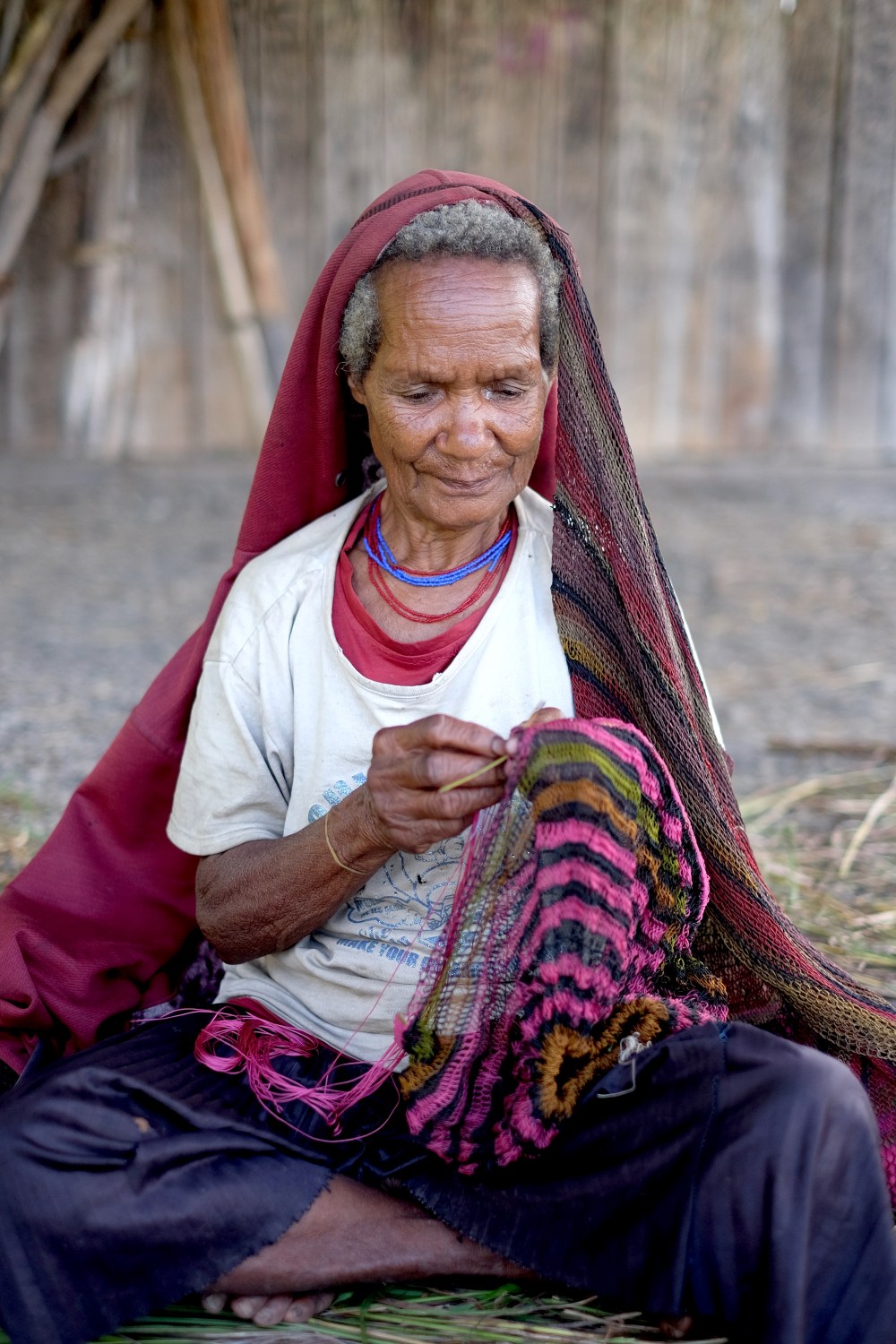
On the way we stopped at a small market and bought a few bananas. I took a photo and was immediately asked for money. This presents a themes for the day, and another noticeable difference. Every person we met asked for cigarettes, sweets or money. In PNG nobody asked me for money, and any photos I took were usually because they wanted to see themselves in a photo. Tourism is bigger business here, and people have learnt to take advantage of it.
However, in spite of the transactional nature, I did get some excellent photos. In particular a few guys working the roads with Wild Bore tusks as nose piercings, and the Dani men with their penis gourds; a little yellowish funnel into which the penis is lifted, concealing the shaft but presenting the scrotum. Apart for a few arm bands and a headdress of feathers, that’s about all they ever wear.
After lunch we headed up to another local village. My guide was looking for a woman with her fingers amputated. He wanted me to take a photo. She had cut off her fingers as a sign of her bereavement at losing her husband and children. In spite of my reservations I met her and she was really very lovely and still affected by her loss. I didn’t want to take her photo, and when it was unavoidable I tried to first take a portrait of her face, but the surrounding people shoved her hand into view and there was nothing to be done. This type of mutilation is typical of the women in the area, and in the following days I see many more women with missing fingers and thumbs.
After we reached the little village there was basically nowhere else to go, so I suggested we just hike upwards. Two boys who had been following us for sweets and for something to do joined us and led the way. The boys (about ten years old) used their big bush knives to cut through bushes and make spears as they walked. At the top there was little a cave they used as a den and sometimes to sleep in. They sang songs, whistled and danced, and put moss and leaves around their heads as they walked. On the way down they slid down a dried stream bed on a bushy branch.


The small stone villages were well kept and lovely. Again, there seemed to be more infrastructure, even out of the townships. More concrete, more schools. The traditional round, thickly-thatched houses sit alongside concrete and corrugated ones. We ate supper with my guide’s family and I took a dip in the river.


The next day we explored further into the valley, traversing along the river gorge, passing more settlements and small villages. We ate lunch in a traditional round thatched house; the entrance was about a meter high and inside there was a central fire pit with four thick wooden beams that supported a ceiling. Simple tools hung from the ceiling and were placed in the wooden buttresses that secured the round interior. The floor was dried grasses and the roof was charred black from the smoke. A small electric light hung from the ceiling next to a small hatch and a ladder which led up to a sleeping space in the roof above the central fireplace. The ground floor was about a meter and half high so that you had to kneel or stoop to get inside and the top floor was one open plan area where the whole family slept. At night they light the fire under them to keep warm.
I quickly ran low on cigarettes and sweets. Virtually every Papuan I met in the valley held out their hands in expectation. Though they do it as nicely as they can, it’s sad to see and speaks of the situation the Papuans are in. Over the border in Papua New Guinea, the locals own the land. They give permission for people to use or cross or dig on their land. If a hotel is to be built or a mine to be dug, businesses must negotiate with the local tribe. Not so in Papua. In Indonesian-occupied Papua, the government owns the land and all its assets. Areas like the Bailem Valley are reservations where the Papuans are ‘permitted’ to live. They are a more ‘developed’ country, but here the Papuans are disempowered, unable to enter politics and often treated as second class citizens.
My guide’s English was pretty terrible, but in one conversation we had about the situation he explained it quite beautifully. He said that the Indonesians give the Papuans rice, but they don’t invite them into their house to eat it, “They give rice, but they leave it outside, like leaving food out for a dog”. With development has come reliance and disenfranchisement. In the villages of Papua New Guinea they often lack basics such electricity, plumbing and roads, but working together the villages grow and build whatever they need. They even grow their own tobacco; using large dried brown leaves and rolling them in dried newspaper to smoke. Remarkably it works. And, in spite of the newsprint, I’ll wager that there are less harmful and addictive chemicals in those than there are in the awful-looking Gudang Garam cigarettes that people smoke in West Papua. From what a saw, it seems that though they are lacking in some things, the native Papuans fare an awful lot better on the east of the island.
We finished exploring the valley and made our way back across the dried river bed, towards the sealed roads where the scooters were waiting in abundance to ferry us into town.


 What goes up