This article was published in the Jan/Feb 2018 issue of Trek & Mountain magazine
…
The Kokoda Track takes you roughly halfway across Papua New Guinea in a straight, single-file line through the Owen Stanley Range, from Owen’s Corner on the outskirts of the country’s capital, Port Moresby, to the small village of Kokoda in Oro Province. Over ninety-six kilometres, there are twenty muddy peaks concertinaed together, so despite the relatively short distance and low altitude, the total ascent is equivalent to climbing from Annapurna basecamp to the summit of Everest.
Though established as a postal route by the British, the trail is famous as the site of one of the bloodiest conflicts in the Pacific War. 2017 marked the 75th anniversary of the gruelling campaign that saw a poorly prepared and ill-equipped Allied forces – mostly Australian – defending against the invading Japanese.
The trail requires a license and a guide. Given the reputation of Papua New Guinea as a difficult place in which to travel (cannibals, Raskol gangs, volcanoes, etc), these tours are usually arranged from abroad, and come with a heavy price tag I simply could not afford. I also wanted to carry my own food and equipment, so I took a punt, and when I arrived in Port Moresby, headed straight to the Kokoda Track Authority office to see if there was another way.
On the third floor of a department store at the end of a long and intimidatingly over-lit corridor, is the office where permits are issued. I was welcomed with large, slightly confused smiles as I explained who I was and what I wanted. They led me into their boardroom and told me to wait. Over a few hours various people came and went, conversations were held that I didn’t understand and then, eventually, three men – Allan, Noel and Bob – from the Association of Guides and Porters suddenly stopped their meeting to address me. A few minutes later an offer was on the table and I had myself a guide. No porters. No fuss. Just me and Allan.
We arrange to meet early and get a head start, but a problem with transport means we don’t get going until late morning. Tired of waiting, we hail a local cab. As we leave the dusty, littered city behind us the countryside becomes progressively more dense, green and impressive. A series of sharp switchbacks take us higher. The driver dodges craters in the road, his head bobbing either side of fat cracks that dissect his windshield. Alien-like black boulders are scattered everywhere; like someone has opened a giant bag of charcoal at the top of the mountain and let the nuggets tumble down.
We arrive at the triple arch that marks the entrance to the Kokoda Track. The trail starts downhill, a muddy ochre slide peppered with jaundice puddles. The going is quick, and although my pack feels on the heavy side (approx. 18kg), it doesn’t cause too much trouble. I’m walking with my guide Allan and his young son, Lalo, who is learning the ropes. Lalo doesn’t like to talk. As I am carrying my own food and equipment, Lalo and Allan are each taking a full porter’s food load to be delivered somewhere up the trail. Lalo is barefoot. Allan is in flip-flops.


We climb down to Goldie River for a thigh-deep river crossing; I’m already caked in thick, sticky mud. At the crossing I’m befriended by Terry, an enthusiastic ex-military Aussie guide, and his two travelling companions. Around us is a constant flutter of tropical butterflies; from small luminous butterflies no bigger than a penny to graceful giants as large as your hand. All-in-all, it’s a pretty nice way to start.
The hills around us are domed and thick with vegetation; like rows of mossy molars with the occasional jagged bare snaggletoothed rock poking through. Our first day is cut short as there are four large groups up ahead. Some groups seem to have twice as many porters as hikers and they have taken all the camping spaces so we, and the Aussies who have adopted me, stop a few hours short at Good Water; a place that lives up to the name, boasting a pristine creek to bathe in along with simple open-sided shelters. Overhead, swallows and bats take turns dive-bombing insects.
We are up the next day at four-thirty, in time to hear the chirp of frogs turn to birdsong and set off while the air is still chilly. We climb what was known during the war as the Golden Staircase; a steep climb boxed in a wooden staircase to help transport troops and munitions to Imita Ridge. The stairs long since rotted, the footing is now a tangled nest of thick tree roots.
As we traverse narrow ridge lines with near vertical sides, Terry points out places where skirmishes and battles were fought. Most of these battles saw the Japanese fighting their way uphill, which when you see the terrain seems impossible. Unsurprisingly, they endured heavy casualties. In those close encounters hand grenades are the most effective weapon for defence and the Australians would toss hundreds of them down onto their enemies.
The steep ups are punishing and the sharp downs are treacherous and unforgiving and in the mid-afternoon a heavy storm drenches everything. As we climb higher the soil changes colour, so now we walk through streams of fizzing orange pop that bubble over our boots. My pack feels heavy, my feet are tired and I start to wonder if I’ve taken on too much.
Around midday Terry begins to feel unwell, ‘I got something on my back’, he says. Which is particularly worrying as Terry seems like a man with the constitution of cured meat. We cross the Maguli Range for three hours, starting with a very difficult steep ascent, followed by a short flat and then a steep downward climb into Nauro Village. After thirteen hours of walking and having bested three significant peaks in a day, we finally arrive at camp; tired, bruised from the inevitable falls, and very, very hungry.


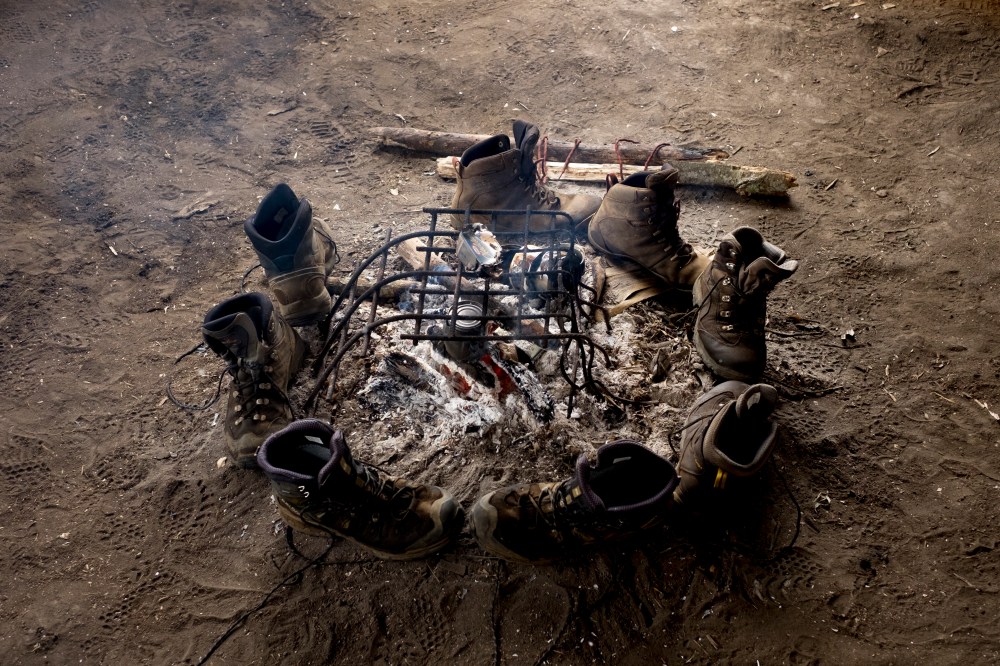
Sweat, humid air and muddy puddle-ridden ground have all conspired against us. Head to toe everything is soaked, so we sit by the fire and dry our boots. Unfortunately this wasn’t an option for the WW2 troops. Australian forces were issued equipment made for WWI, including leather-soled boots and only one pair of socks. Most of the soldiers dumped their socks and opted to keep their boots on at all times. Terry tells us about a soldier who finally removed his boots after weeks in the field to find the flesh between his ankle bones and Achilles had rotted through, leaving only a gruesome hole.
We wake at five and start walking at six. The mood is sombre and functional. From Nauro we head downhill towards the marshes and an easy flat through the Brown River Swamp. Long slender logs laid end-to-end provide a tightrope for us to cross the boggy patches, but where the ground is dry we are able to walk in double-file, passing through a wide boulevard flanked with giant stooping trees heavily bearded with moss. We cross the river and arrive at ‘The Wall’, an hour of hellishly steep, strength-sapping incline leading to the Menari Gap. Terry (who I came to learn is ex-SAS, anti-terrorism and sniper-trained) is still not well and is finding it tough; stuck at the back, mute and pushing through, at intervals lying prone by the side of the track with his eyes closed. It looks bad.
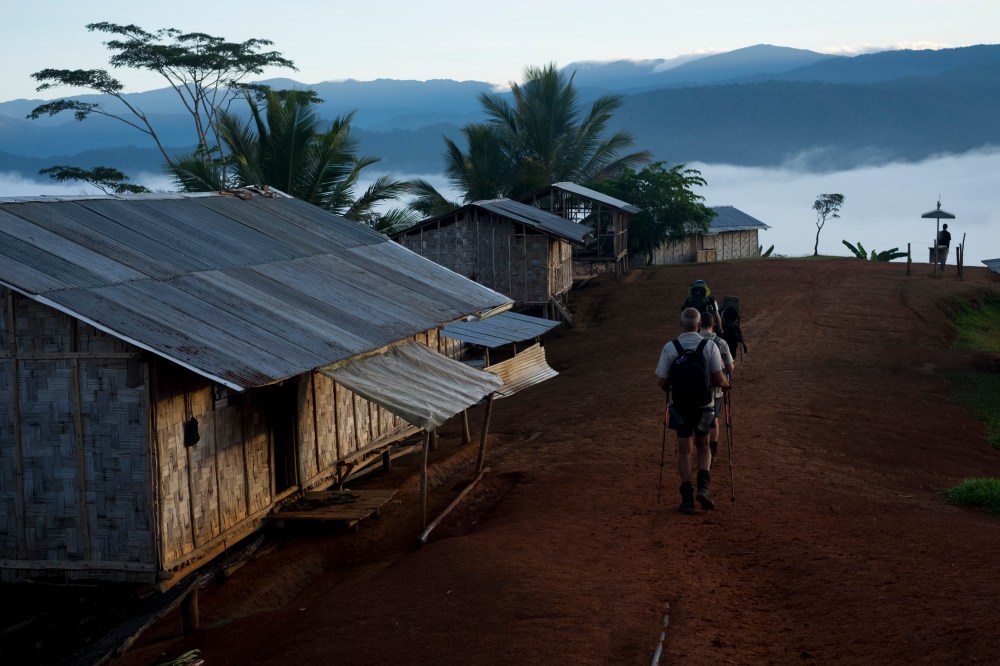
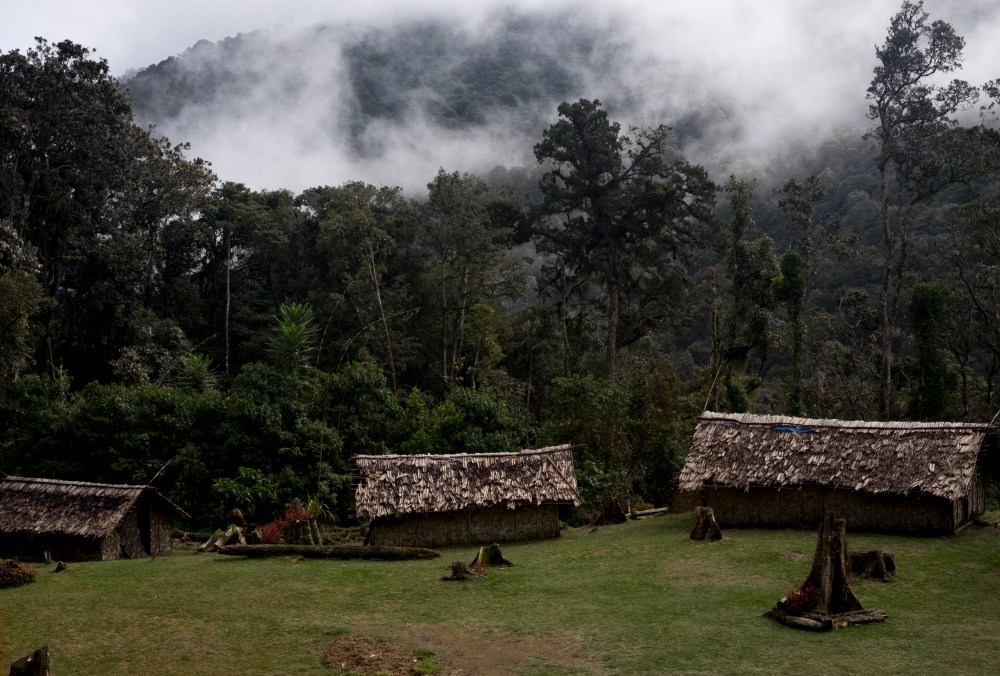
We stop at the small village of Menari for lunch. Neat wooden stilt houses sit on perfectly dug-out and flattened patches of earth; a red foot-flattened football pitch acts as a town square. At the edge of the village large communal gardens have been cleared, cultivated and fenced to prevent wild pigs eating the crops. In neat rows the village grows sweet potatoes, yams, corn, pineapples, papaya and bananas. Some 87% of Papua New Guinea’s 8 million population live in remote rural areas, primarily in small subsistence farmed villages dotted across the country’s giant carpet of forests. Over 65% of Papua New Guinea is pristine forest. After the Amazon and Congo, it’s the 3rd largest remaining rainforest block in the world.
Day four and a stone staircase leads us down to Mission Ridge where, in a single 36-hour period, the Australians threw 1,200 grenades. You have to be pretty close to throw a hand grenade at someone, and the damage they must have inflicted is hard to imagine.
The concentration required to negotiate the steep downhill climbs is intense and mentally draining. Whether the footing is mud, nested roots or stone, it is treacherous and slippery. There are no safety holds and falling could see you tumbling to a bone-shattering conclusion. At the head of our line is Vincent, the burliest of our guides, whose job it is to set the pace. As he goes he cuts steps into the hillside, where the eroding water has slicked them down. In spite of this, we all take a tumble at some point; even Vincent.
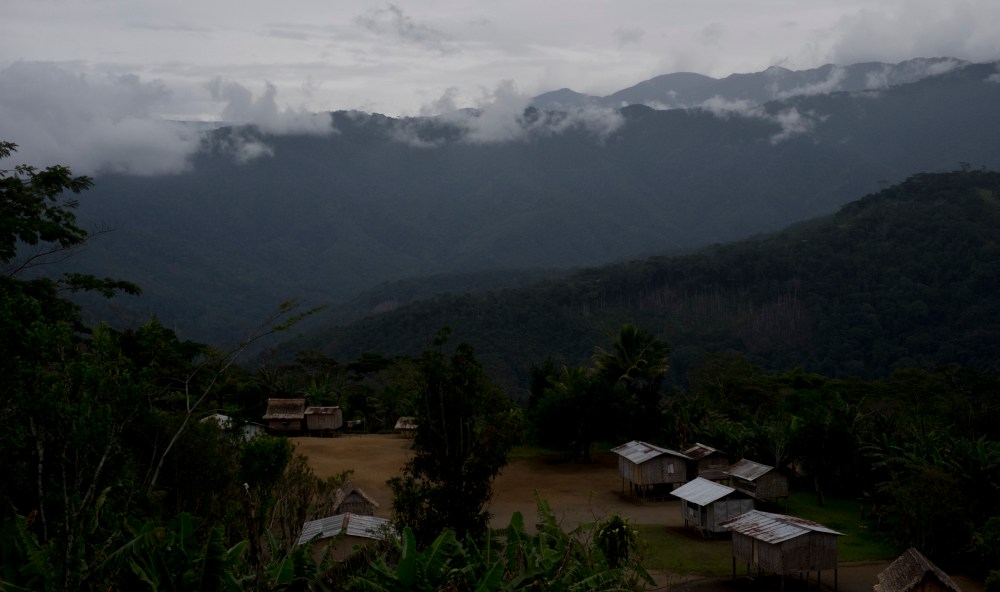
We pass down narrow stone pathways, through a creek and down a waterfall, past shimmering red leafy bushes and under a ceiling of white trumpeted flowers. Another stiff climb takes us into Naduri where we buy bright fruit and giant avocados. Most of the walking is through the shade of the jungle, but occasionally we pass through open faces where the expansive valleys and lush hills unfold in front of us; dense green prickled with delicate dabs of colour from the endless variety of trees. The mountain-tops always crowned with mist.
One last climb and then down through tall trees to the crash site of a Japanese WW2 Bomber. Parts of the fuselage, landing gear and machinery lie twisted in piles. Live .50 calibre machine gun bullets are scattered on the ground. We set down for the night at Campsite 1900 in the Myola range. To beat the cold I sleep fully clothed.
The cool carries through to the morning and makes for an enjoyable start; the air tastes fresh and crisp and we walk an hour before breaking sweat. Even the ground has firmed up and it’s nice not to have to think about making adjustments each time your foot meets the floor.
We climb a spur steadily for an hour-and-a-half, finally reaching the ridge and cresting Mount Bellamy, the highest summit, at 2190m. The summit itself is unremarkable, so we take the necessary photo and move on quickly, down the steep path into Eora Creek and over a vine-bound wooden bridge at Templeton’s Crossing. This is where the Japanese finally abandoned the trail and retreated to Buna on the north coast. Their relentless attitude (notoriously having no word for ‘surrender’ in Japanese) led to intense suffering. By the time they were in view of Port Moresby, the Japanese soldiers were so starved and ridden with dysentery that some began cannibalising their own porters.
After lunch Allan, Lalo and I wave goodbye to our Australian companions. We have a flight to catch and Allan has had word that they have decided to leave a day early, so we are playing catch up. We plough ahead, climbing without break and descending at skipping pace. We leapfrog over and slide under fallen trees. Giant dense hardwoods too big to move, with notches cut in to allow you to get a hold. Some are so big there are small wooden bridges to cross them.
A short detour and we arrive yet another stash of military artillery, including mounds of unexploded hand grenades, 3-inch mortars and giant field shells that hold up to five kilograms of plastic explosives. This land is owned by Allan’s family; all the way to Alola village, about a two-hour walk. Allan tells me that as a child he and his friends would light a big fire, throw in a mortar and wait for the fireball. As you do.


In spite of our efforts, when we reached Alola it is just past four, going dark and raining. To make the plane we would need to push on. But after a ten-hour day with only thirty-minutes break, and with tough terrain still ahead, we decide to camp down. Allan and Lola build a fire as I sit resting in the corner of a dark, smoky hut. Allan cooks deep green choko vine to eat. Everything smells of smoke.
Day six, and on the final morning I awake to the gentle crackling of battered pancakes. A treat from Allan. We leave the village, cross a waterfall and, aptly for this walk, begin a steep uphill. My cold legs protest at every step. We are now walking on Lalo time; which is to say that we are not dawdling. We do everything at pace, hopscotching around quagmires and springing to the firm spots where the roots are thickest. As we descend the air becomes humid and the vegetation takes on a wet sheen; bushes of chubby, striped leaves gleam like sucked Humbugs.
We have almost arrived at the end of the range; the broad flat expands beneath us. As we get lower, we are once again surrounded by butterflies; large lily-white butterflies with yellow camomile-flower spots on their wings. At Hoi, the last village on the range, we take a final cool dip. Purple and blue dragonflies skitter across the bubbling water.
Out of the blue Allan gets word that the flight, which was due to leave at eleven that morning, hadn’t actually arrived yet due to the poor weather. So we finish at a sprint. I can’t tell you much about Kokoda because we fly past it in a blur. It looks nice enough; bigger than all the other villages, with stalls lining the road and people generally chatting and milling about. With time to spare we get to the airfield, which consists of a long grassy field and an open concrete shed. We and our bags are weighed. Our seats are secured.
The Kokoda Campaign finally ended on 22 January 1943 after six months of bloody and desperate fighting. 2,165 Australian troops killed, 671 US troops killed. Of the near 20,000 Japanese landed in Papua between 21 July 1942 and 22 January 1943, around 13,000 died there. And the Papuans, serving on both sides, lost approximately 1,350.
After a bumpy take-off, we sail into the clouds and fly low through the mountains. The short flight gives us one last lingering look at the crumpled green carpet we just crossed.
…
This article was published in the Jan/Feb 2018 issue of Trek & Mountain magazine: Kokoda Trail – Trek & Mountain


 What goes up